Welcome to Economics for Kids: Fun Economics Lessons from Fables & Fairy Tales, featuring Canberra’s iconic landmarks.

This book was inspired by a curious boy’s endless questions about the world and my passion for making complex ideas enjoyable for children. 

As a mother, economist, author, and educator, I believe learning should be an adventure filled with fun, curiosity, and discovery.
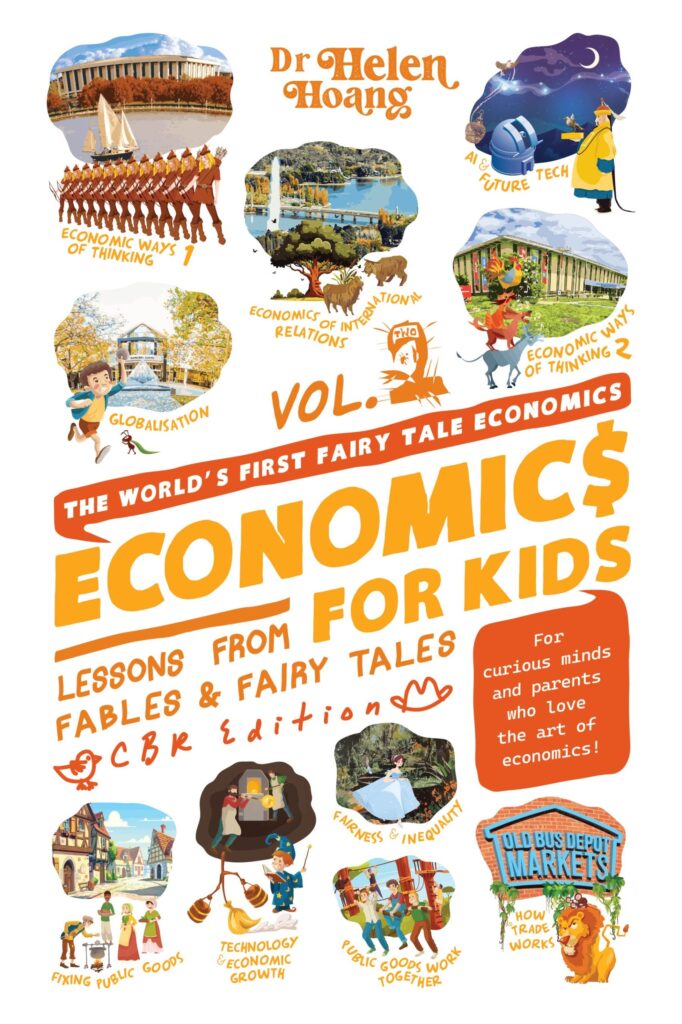
Explore the Episodes in Volume 2

Introduce your child to the wonders of economics with Economics for Kids: Fairness and Inequality, a charming book that transforms classic fairy tales like Cinderella into easy-to-understand economic lessons.

Children will discover the meaning of fairness and equality through Cinderella’s journey, understand the importance of choices and time, and explore how decisions impact the environment and the well-being of the kingdom.

Designed to spark curiosity and encourage thoughtful conversations, this book series helps kids build a foundation in economics while inspiring critical thinking and compassion about the world around them.

Introduce young readers to the idea of public goods with The Bundles of Sticks, a beautifully illustrated children’s book that makes economics simple and fun. Through this classic tale, kids learn how teamwork and sharing resources—like a bundle of sticks—make communities stronger and more resilient.

Children discover what public goods are, using easy examples to show how non-rivalrous and non-excludable resources benefit everyone when people work together.

Ideal for parents, teachers, and educators, this book is perfect for teaching kids ages 7–12 about the value of unity, collaboration, and the importance of public goods in our everyday lives.

Explore the world of economics with Fixing Public Goods: Lessons from Fables and Fairy Tales.

Using the classic fable The Bundle of Sticks, this engaging children’s book introduces key concepts like the 80/20 Rule, public goods, positive externalities, and negative externalities.

Through captivating storytelling and illustrations, kids learn how teamwork, shared resources, and smart decision-making can solve real-world economic challenges.

Perfect for parents, educators, and curious young minds, this book makes economics easy, fun, and unforgettable—helping children understand how economic ideas shape the world around them.

Explore how technology drives progress in Technology & Economic Growth, a lively children’s book from the Lessons from Fables and Fairy Tales series. Follow The Apprentices as they use innovation and teamwork to solve challenges and show how new ideas shape our world.

Young readers will discover how technology fuels economic growth through concepts. The story also highlights the importance of responsibility when inventing and using new technologies.

Packed with engaging storytelling and real-world examples, this book makes complex economic ideas fun and easy to understand, inspiring curiosity and critical thinking about innovation, sustainability, and how economies grow.

Introduce Economics For Kids: AI & Future Tech. Through captivating storytelling, children explore innovation, automation, and creative destruction—learning how new inventions can change jobs and reshape our lives.

Kids discover that while AI and robots offer many benefits, only humans bring creativity, emotion, and unique magic to the world. The book also highlights the importance of ethics and responsible use, showing young readers how to balance technological progress with fairness and safety for all.

Part of the Lessons from Fables and Fairy Tales series, this book makes complex topics fun and accessible, encouraging children to think critically about technology, creativity, and what it means to be human.

Discover the magic of trade and teamwork in How Trade Works, a vibrant children’s book that makes core economic concepts easy and fun to understand.

Through the classic fable of The Lion and the Mouse, kids explore globalization, the division of labor, and how countries cooperate to exchange goods and knowledge.

Children learn how nations trade and collaborate to create better products and services, while also understanding the importance of fairness, cooperation, and environmental responsibility. Inspired by Adam Smith, the book shows how focusing on strengths—whether as individuals or countries—makes teamwork and production more efficient.

Journey into the world of globalization with The Ant and the Dove – Winners and Losers, a playful children’s book that makes big economic ideas simple and fun. Through the classic fable, kids learn how countries trade, collaborate, and depend on each other in the Global Village.

Young readers discover how globalization connects nations, creates opportunities, and why teamwork, fairness, and sustainability matter—since not everyone benefits equally from trade. The story highlights how countries, like the Ant and the Dove, specialize in their strengths to drive growth, innovation, and shared prosperity.

Part of the Lessons from Fables and Fairy Tales series, this book uses relatable storytelling to make global economics accessible, sparking curiosity about teamwork, fairness, and our interconnected world.

A timeless story that introduces kids to important economic and social ideas like international relations and adaptable policies. Through engaging storytelling, children learn how nations work together, adapt to change, and build strong, peaceful connections.

Kids will see how strong diplomatic ties promote trust and cooperation, leading to shared success—just as teamwork in the story brings harmony. The tale also shows the importance of flexible decision-making, with the Reed’s adaptability helping it withstand challenges, much like nations responding to economic shifts.

This book makes complex concepts easy to grasp and inspires young readers to value collaboration.

Introduce kids to the power of economic thinking with The Twelve Huntsmen, an engaging story that makes critical concepts easy and fun to understand. Through this captivating tale, young readers learn the importance of skeptical inquiry—questioning and verifying information just like the prince tests the hunters for truth and reliability.

Children also discover why staying curious and seeking accurate information leads to smarter decisions, while relying on outdated assumptions can cause mistakes. The story encourages kids to test ideas, stay fair, and make choices that benefit everyone.

Part of the Economics for Kids series, this book inspires curiosity and critical thinking, helping children develop the skills to make informed, thoughtful decisions in everyday life.

Introduce kids to economic thinking with The Bremen Town Musicians, a lively story that makes teamwork, adventure, and problem-solving fun and easy to understand. Through the animals’ journey, children learn how collaboration and combining unique talents can help achieve more—just like the musicians scaring off the thieves together.

The story also highlights the value of exploring new opportunities and venturing beyond comfort zones, as well as the importance of creative problem-solving and thoughtful planning in overcoming challenges.

Part of the Economics for Kids series, this book transforms timeless lessons into relatable economic concepts, encouraging young readers to think creatively, work together, and embrace new adventures.